
AMT Agence Metropolitaine de Transport
(Edited by Jean-Francois Turcotte)
amtnews@canadianrailwayobservations.com
Train de l’Est:
On September 8th AMT showcased the now-completed Mascouche station to the media. The Anjou and St-Léonard – Montréal Nord station are also completed and ready for service. Work continues at a rapid pace on the Ahuntsic, Sauvé, St-Michel-Montréal Nord, Rivière des Prairies, Pointe aux Trembles, Repentigny and Terrebonne stations. Test trains have been running infrequently between Central Station and Mascouche to qualify the staff and to test the signalling system.
Mostmajor Mascouche line-related track work on the St-Laurent, Joliette and Mascouche subdivisions have now been completed. The following diagrams denote the major change in infrastructure:

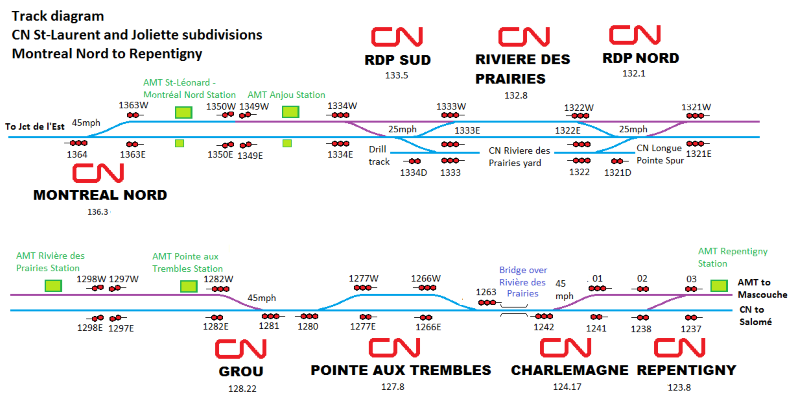
Note: purple denotes new trackage added as part of the Mascouche line project. Only main tracks are shown.
AMT will launch the new Mascouche line on December 1st 2014, and will be offering free trips on this line for the next two weeks (ending on December 12th). The Pointe aux Trembles and Sauvé stations will not be ready by December 1st and will open in early 2015.
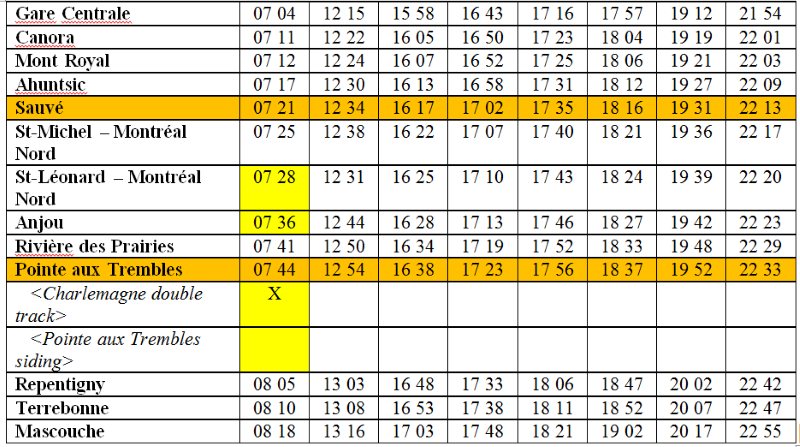
A preliminary and unofficial schedule has been released (yellow-highlighted cells denote a train using an alternate platform or siding in order to meeting an opposing train).


More information about the Mascouche line can be found on AMT’s website (in French) :
https://votrenouveau.amt.qc.ca/fr/actualites/projets/train-de-l-est
AMT complains to CP about poor timekeeping :
AMT is increasingly frustrated at landlord Canadian Pacific over poor timekeeping on the Vaudreuil, Candiac lines and St-Jérôme lines. Delay occurrences are significantly higher in 2014 than they used to be in past years, mostly owing to interference with freight trains, with the Vaudreuil line getting the lion share.
Major operating changes have occurred in the past years at Canadian Pacific following the replacement of former CEO Fred Green by Hunter Harrison (himself rival CN’s former CEO) under pressure by activist investor Bill Ackman, and AMT may be a collateral victim of those decisions.
Among them is CP now running fewer but longer and heavier freight trains. Those extended trains sit longer through control points, thus reduce the system’s fluidity. Main tracks can also be blocked over extended periods because the trains are now too large to fit in yards or between control points, and must therefore sit on the main. Longer trains are also more prone to knuckles and drawbars breaking, and take longer to recover from such incidents. Some trains also running with less horsepower per ton, therefore accelerate more slowly and in some cases may be unable to reach track speed, further reducing the system’s fluidity.
Another major change was the closure of the Montreal dispatching office at Windsor stations. Canadian Pacific’s eastern network is now being dispatched from distant Calgary, and while some Montreal dispatchers agreed to be relocated, many did not and the new dispatchers may not yet have had time to familiarize themselves with their new territory and its intensive commuter rail traffic.
Many voices are calling for AMT to build its own rail corridor between Ste-Anne-de-Bellevue and Ballantyne (Lachine) to avoid such interference – AMT’s Train de l’Ouest project. Although the preliminary engineering studies have been released, no funding has been identified for this expansive and expensive project so far. AMT also recently introduced a competing project to link downtown with the Dorval-Trudeau Airport and the Fairview terminal using an elevated light rail system, similar to what has been proposed on the new Champlain Bridge.
So far, the only near-term improvement for Vaudreuil line riders is the replacement of the directional ABS system by bi-directionnal CTC between Ste-Anne-de-Bellevue and Dorval, which will enter service this Fall (with new medium speed crossovers at Ste-Anne-de-Bellevue and Beaconsfield). AMT plans adding two inbound and two outbound rush hour runs on the Vaudreuil line, although equipment is currently running scarce. Stored 900-series gallery cars may be pressed into service to handle the additional service.
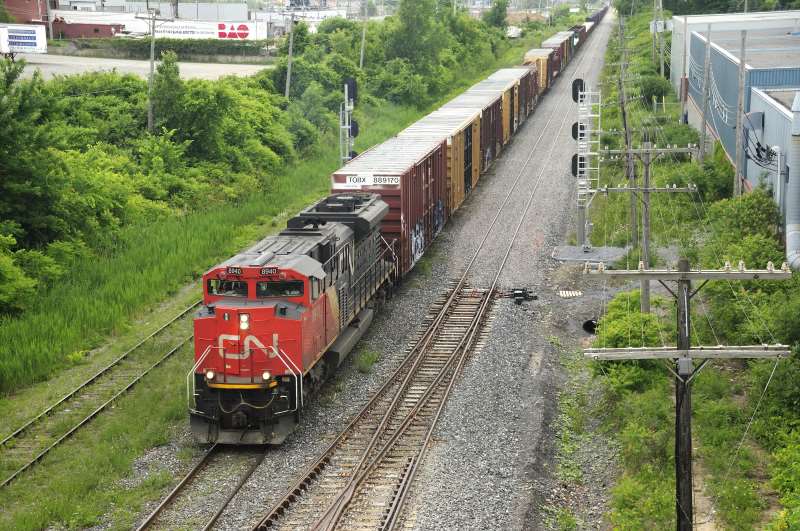
CN train 587 (Rivieres des Prairies – Joliette local) is
leaving Riviere des Prairies yard on the heel of 368. The new West
main track is in the foreground, as signals for control point Riviere
des Prairies Nord loom in the background.
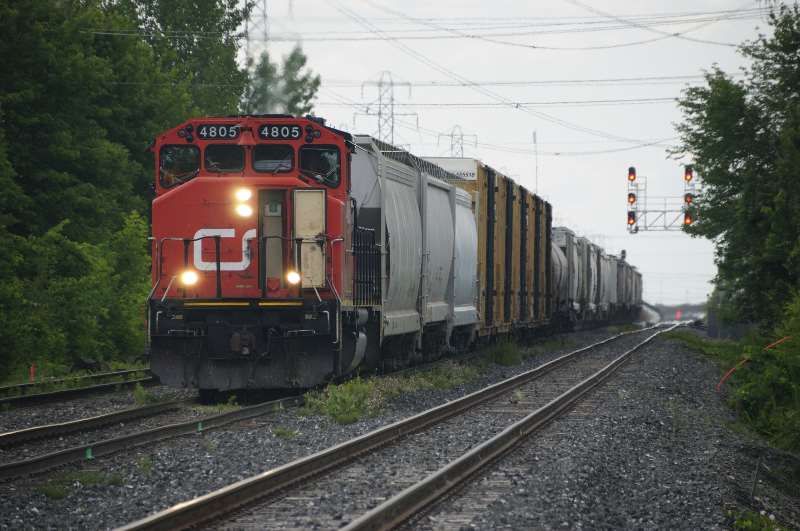
Charlemagne is a new control point where AMT’s Mascouche
subdivision joins CN’s Joliette subdivision, as seen from the
St-Jacques street crossing (with a medium or limited speed
turnout). Control point Repentigny (with a diverging speed
crossover) looms in the background. The green light on the right
is for CN 587.
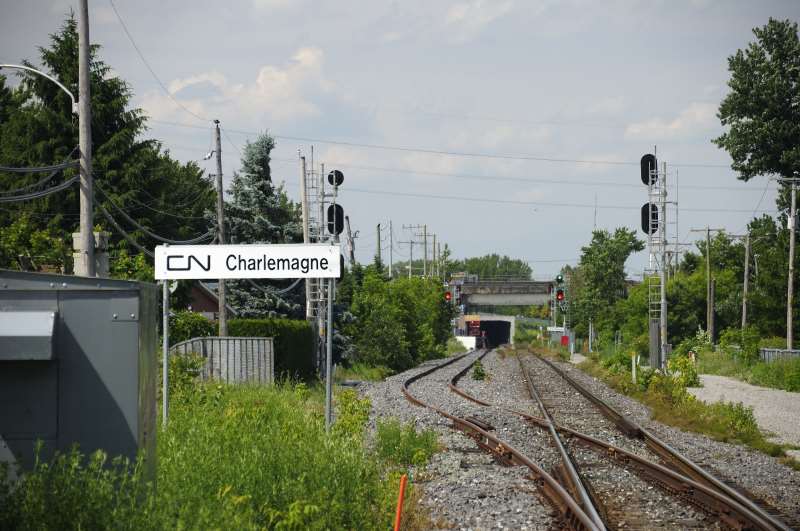
AMT’s new line skirts a General Dynamics ammunition plant,
requiring a protective berm shielding the train from explosions.
Seen from a new crossing at Chemin de la Presqu’ile:

Seen from the same crossing, a steeply-graded overpass
carries AMT’s new line in the median of highway 640 for the ride to
Terrebonne (Lachenaie) and Mascouche.
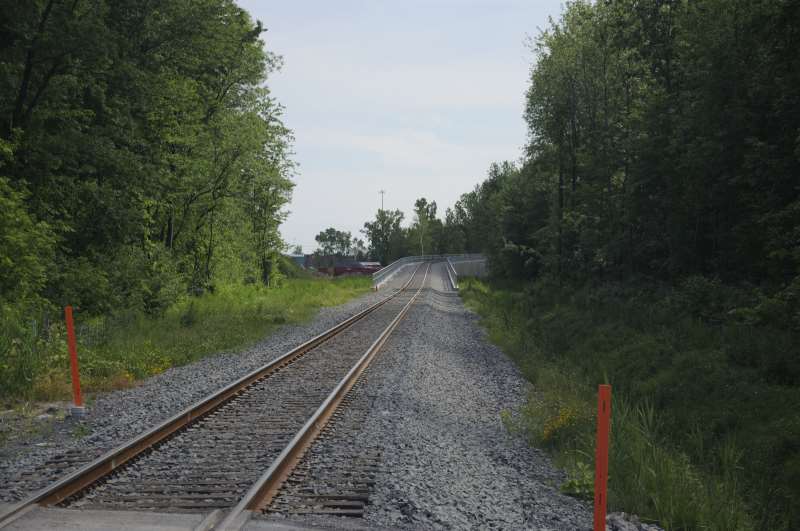
AMT currently is running test trains between Mascouche and Repentigny, and will soon start testing all the way into Central station, once the dual-mode ALP-45DP’s are cleared for use in electric mode.
Meanwhile, all stations are now under construction or complete. Mascouche, Terrebonne and Repentigny stations feature high-level platforms.
Trains de l’Ouest :
AMT’s Train de l’Ouest project seems to be caught in a political daydream. On July 7th, Quebec Transportation Minister Robert Poeti vowed to fulfill AMT’s expansive Train de l’Ouest project by 2017, but this seems highly unrealistic given the huge scope of the project, which includes a pair of new dedicated electrified main tracks running along CP’s Vaudreuil subdivision. The project is estimated to cost at least one billion at a time where public money is scarse and likely to be directed to competing projects (Metro blue line extension or Champlain bridge LRT or BRT).
Poeti also announced that AMT would proceed with the planned acquisition of 23 new Multilevel cars to expand service on the Vaudreuil-Hudson line (at a cost of 80M$), but again seems confused. AMT’s planned use of the new Multilevel cars is to relieve severe overcrowding on the Deux-Montagnes line, proceed with the mid-life overhaul of the MR90 electric multiple units and prevent a severe car shortage given the recent service expansion on the St-Jerome line.
In order to allow diesel-ladden ALP-45DP dual mode locomotives to safely operate in the Mount Royal tunnel, AMT temporarily suspended service on the Deux-Montagnes line on September 20th and 21st to install new safety features in the tunnel:
CRO reader AMTFan1 has released videos, and photos of various AMT trains, captured at Summer of 2014,
Photos
http://amtfan1.deviantart.com/art/AMT-electric-train-heading-to-downtown-Montreal-478395913
http://amtfan1.deviantart.com/art/Train-arrival-at-Saint-Lambert-477959468
ONR North Bay Shop video of the refurbished Bombardier coaches for AMT.
AMT Vignettes
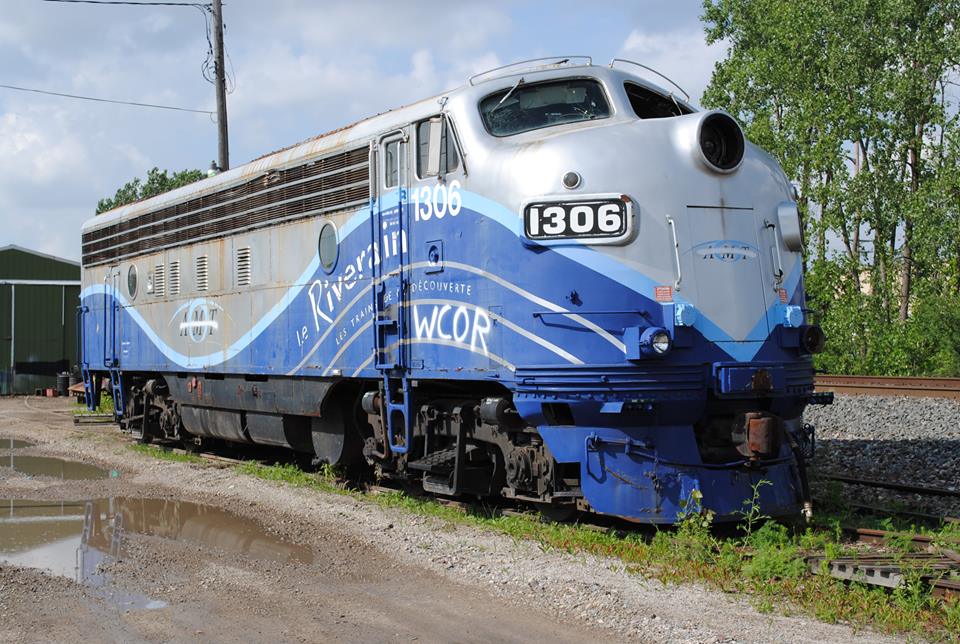
Former AMT FP7A 1306 was photographed on July 27th, at Sillcot Railway Equipment, in Worthington, OH by Stephen Timko. Wearing her fading Riverain paint scheme, former AMT 1306 is ex MUCTC 1306, exx- CP 4040 nee-1433). Ex- AMT 1304 is also there. The went to WCOR then to COE RAIL two years ago. A rumor suggests they might get painted into PRR Colors.
GO / TTC NEWS EDITOR: JOHN S. JEFFERY
Please submit your GO/TTC news and photos to:wce1942@yahoo.ca
GO Locomotive Fleet
MP40PH-3C
600 – 666 - see 664 status below
657 – 666 - Equipped for tier three emission control
647 is in Boise serving as the prototype for the twin engine project. Expected back in Toronto for March 2015 for testing.
F59 PH
557 – 564 – rebuilt and in active service
Metrolinx Status Report – October 24th,2014: (Mark Ostler – Metrolinx)
GO 664 – The unit has arrived at CN Macmillan Yard but will not be at GO Willowbrook for a few days. Commissioning a new unit is a four week process. It takes two weeks for prep work and GO Transit – specific modifications at Willowbrook. Then commissioning runs begin, which take approximately two weeks, on average to complete before full entry into revenue service. The new unit operates in the leading position, with a second unit as backup in case of unit failure.
GO 666,665 and 664 – These units were introduced back into the assembly process in reverse order to allow for the addition of a new component, an exhaust silencer. This was negotiated while the units were already in the assembly process. It was decided that work would begin on the locomotive that required the most work, at that time, which was GO 666, and work back from there. Thus the arrival sequence at Willowbrook has been 666, 665, and shortly 664.
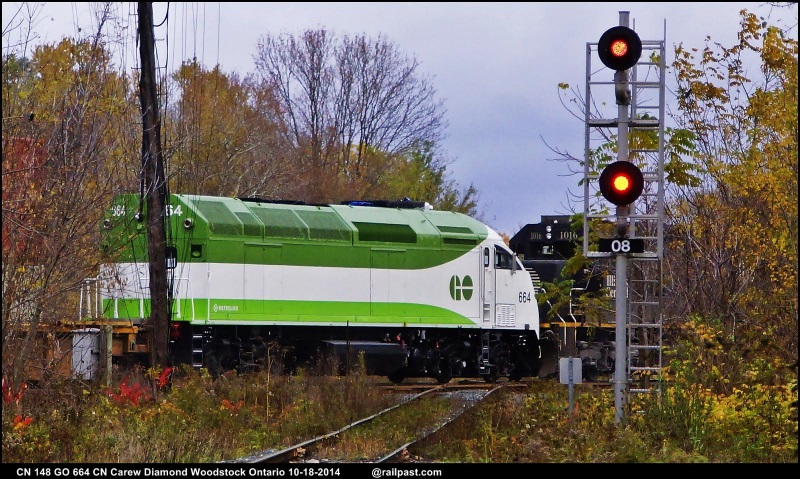
On Saturday October 18th, 664 is passing through Carew Diamond at Woodstock, on the CN Dundas sub. This is the last unit in the current order for ten MP40PH-3 from Motive Power Industries in Boise Idaho. The unit is headed eastbound to MacMillan Yard, for final delivery to GO Transit Willowbrook Yard in Etobicoke.
Thank you to Walter Pfefferle of railpast.com for sharing this photo.
GO Transit Expansion Projects: Status update October 2014
Kitchener Rail Corridor Infrastructure Expansion
Georgetown South Expansion
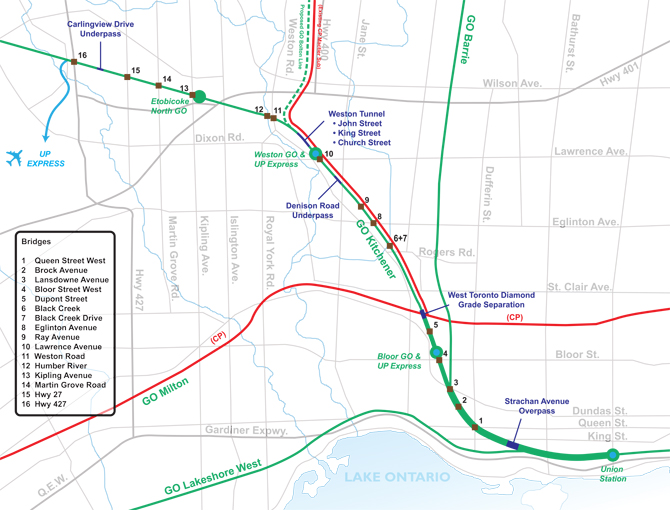
This map outlines the entire scope of the Georgetown South project The project extends from Bathurst Street in the City of Toronto to Highway 427 in the Region of Peel and includes the following improvements:
The 2015 Opening Day Build will include the addition of two tracks resulting in a total
of three tracks in the north half of the GO Georgetown South Corridor and an
additional track to the south, for a total of five tracks.
One new bridge structure at Weston Road will be required; 15 other bridges will be
widened or modified.
A total of seven new overpasses and underpasses will be built to separate vehicle and
train traffic. These will be located at: West Toronto Diamond rail-to-rail grade separation to separate freight and commuter
rail traffic.
A rail tunnel will be built under Hwy 401 in a future phase of the project once an
additional track is needed in the Corridor to meet future ridership demands.
The rail corridor will be lowered in three locations: Liberty Village (Strachan Avenue),
Junction (between Dupont Street and St. Clair Avenue), and Weston. In Weston,
the lowered rail corridor will be covered between King and Church Streets.
GO Transit will continue to stop at Bloor, Weston and Etobicoke North GO stations,
which will require changes to suit the new track alignments. The new Union
Pearson Express will only stop at the Bloor and Weston GO stations.
Major track and grading construction, civil works, signal installations and utility
relocations are required along the corridor.
This work must be carried out with a minimum of disruption to existing train
operations and our neighbours.
Overpasses: Strachan Avenue, Junction Road / Old Weston Road, King Street,
Underpasses: Denison Road, Carlingview Drive
Church Street, John Street (Pedestrian)
Source: http://goweb02.gotransit.com/gts/en/project/default.aspx
Georgetown to Kitchener – trackage purchase
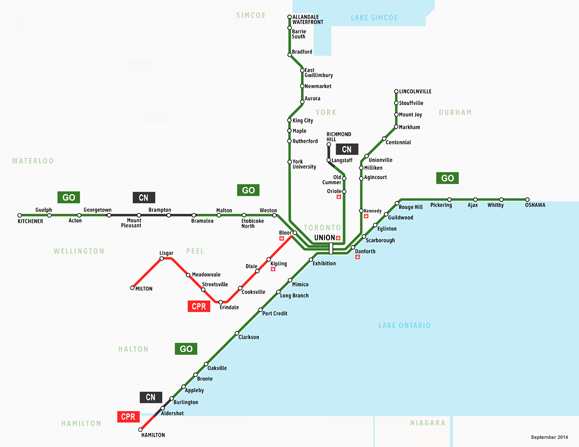
The location of the 53 km of trackage purchased is shown on this map.
GO Transit owns 80% of the trackage they operate trains on. In order to support growth in GO train traffic on the Kitchener Rail Corridor, Metrolinx has purchased 53 kilometres of trackage from the Goderich and Exeter Railroad, between Georgetown and Kitchener. GO Transit will be assessing, this fall and winter, exactly what projects they want to implement, to improve the right of way on this section of the Kitchener Sub.
Source: Metrolinx Georgetown South Project fact sheet
http://www.metrolinx.com/en/docs/pdf/firstwave/Fact_Sheet_GTS_EN.pdf
Union Station Revitalization
This is a key component of the BIG Move Project to improve Transit. This is an essential step to allow additional GO and Union Pearson Express train movements in and out of Union Station
Take a tour of the future Union Station train shed
http://www.gotransit.com/UnionStation/en/default.aspx
New Train Shed Roof and Glass Atrium
Aerial photos of the continued work at the Union Station train shed. The glass atrium will float over the tracks, providing daylight at platform level and a visual connection from the station to the waterfront. The view of the roof, which is visible from offices and other tall buildings in the area, will be improved by a green roof. These changes will help reduce the “heat island” effect that raises temperatures in urban areas and reduce the concentration of rainwater run-off.
Source: https://www.flickr.com/photos/metrolinx/sets/72157635071489426
GO Transit Passenger Coach Fleet:
Mark Ostler has provided the following detail regarding the current Bi-Level coach order:
26 cars in the present order for bi-level coaches, are under construction at Bombardier in Thunder Bay, ON. Six cars (2555 – 2560), are equipped for wheelchair access. The remaining 20 (2839 - 2857), are standard bi-level coaches.(Source: Mark Ostler – Metrolinx)
Transit Toronto, on their website, provide the following details about the entire order of Version VIII Bombardier Bi-Level coaches.
On May 25, 2012, Metrolinx announced the awarding of another contract to produce 60 more bilevel coaches.The cab cars would be redesigned with a larger cab offering improved visibility and ergonomically improved controls. In addition, the cars would have “crash energy management crumple zones” for improved safety in the event of an accident. Promised improvements for passengers included onboard wireless Internet, and “improved ventilation, door and toilet systems”. This order was followed up with another order, announced in January 2014, for a further 65 coaches, bringing the fleet up to 743 in order to expand service capacity. These coaches are set to arrive from late 2016 to early 2017.
Source: http://transit.toronto.on.ca/regional/2507.shtml

New coach 2842 at Oshawa on August 23rd livery. John Jeffery photo , 2014, in the new Metrolinx
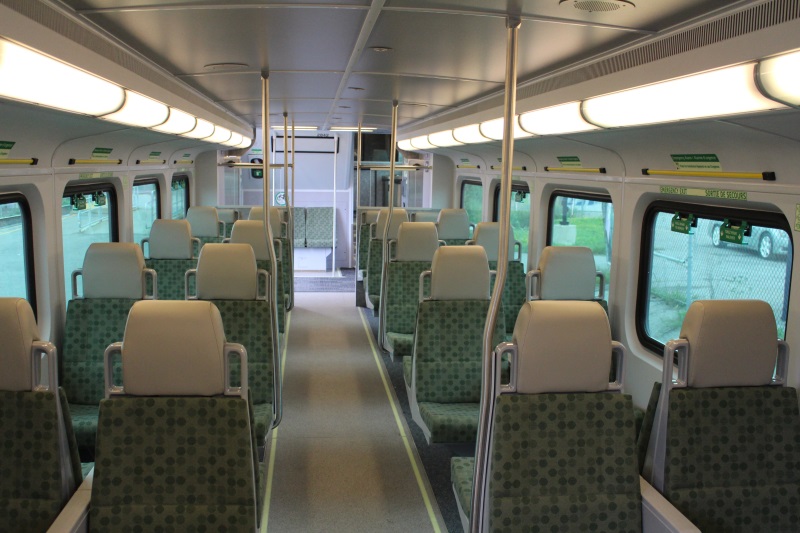
The interior of new coach 2842 at Oshawa on August 23rd , 2014 . Notice the change of colour scheme to earth tones from the older style with blue seats..John Jeffery photo.
Cab Cars:
A new Crash Energy Management (CEM) bi-level cab car project has now completed the final design phase. You can see from the picture below that the front of the car is very different from cab cars 200 through 257, currently in service. The first two CEM cab cars are expected to be delivered early in 2015.
This is the new design of cab car coming in 2015. Notice the aerodynamic styling.
New Station – James Street North, Hamilton
A new GO Station is being built at 353 James Street North in Hamilton to support the growth in population and anticipated GO Transit ridership on the Lakeshore West Corridor. This facility will include a new station building, fully-accessible north and south rail platforms, a Kiss & Ride, new parking lot, a bus loop and pedestrian/bicycle pathways, a full urban plaza and pedestrian bridges to provide more convenient customer access to the train platforms. This project is expected to be completed by spring 2015.
A new layover yard is also being constructed, as part of this project, to store and maintain trains. It will be on the CN Grimsby sub between McNeilly Road and Lewis Road. This portion of the project is expected to be completed by summer 2016.
GO Transit are providing ongoing updates on station construction and you can access this information by clicking on the link below.
(Source: http://www.gotransit.com/public/en/improve/projects/james_street_north_station.aspx )
This station will completed in time for the PanAm Games in 2015. GO will be operating extra trains from Hamilton for those events.
GO Photos
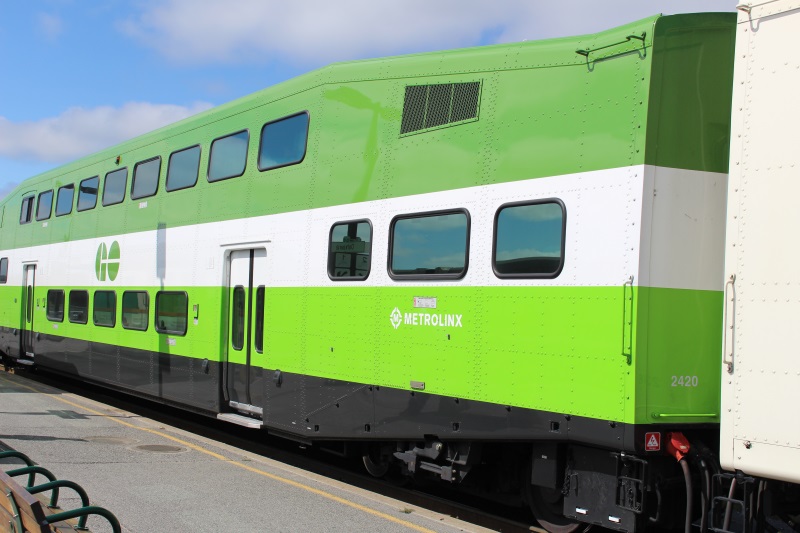
GO 2420 is a regular coach that has been refurbished. It is seen here at
Oshawa. Notice the original blue colour scheme has been retained.
John Jeffery photo
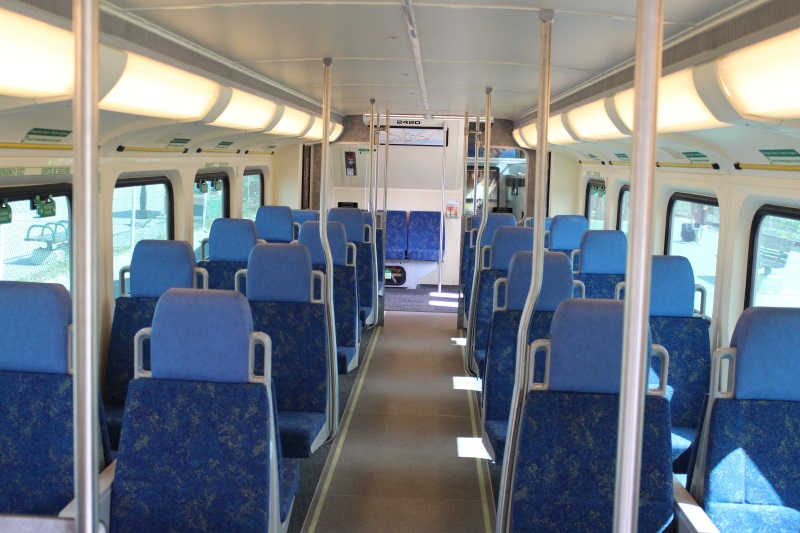
The lower level interior of coach 2420 at Oshawa. Notice that the original blue colour scheme has been retained. John Jeffery photo
GO Vignettes
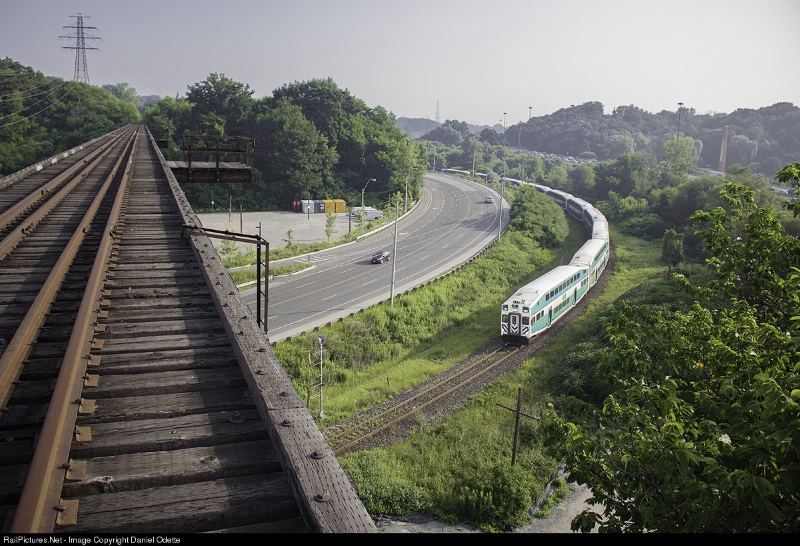
Daniel Odette photographed the last rush hour GO trip from Richmond Hill
passes under the CP Don Branch on its way into Toronto with a crush of passengers.
This bridge, built in 1928, was intended for both passenger and freight train usage
into downtown Toronto on the Belleville Subdivision. The last train to roll across this
bridge was the CP Holiday train in 2007. Since then, it has provided a stunning view
for hikers. One day, this bridge may be used by the very Richmond Hill GO trains that
currently pass below, intending for a shorter route. However, that day is definitely far off.
To the right of the GO train is Todmorden Mills, and steaming commuters crawling along
on the Don Valley Parkway who have opted not to use the GO train.
http://www.railpictures.net/viewphoto.php?id=490712&nseq=0
(used with permission)
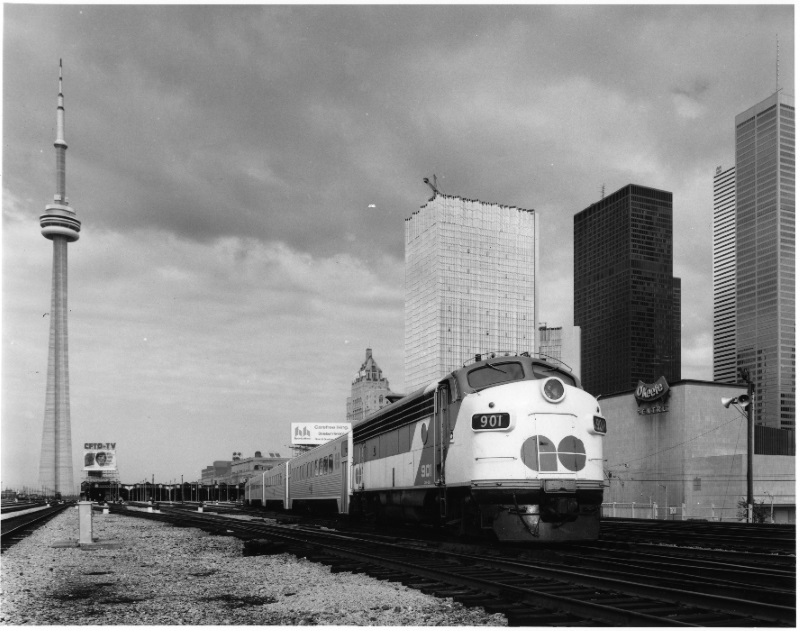
GO 901 APCU unit leads a train eastbound from Union Station headed for Pickering. The prime mover and traction motors have been removed from these units. Michael Taylor notes that “Auxiliary power-cab unit (APCU) #901 was converted from an Ontario Northland Railway FP7A #1505 for use on GO trains”. www.michaeltaylor.ca/Ontario/901.shtml

GO 602 , a GP40TC eastbound from Rouge Hill station, heading for Pickering.
Transit Toronto notes “The first engine that GO Transit bought when it started operations
in May 1967 was the GP40TC series. These were essentially a General Motors-built
GP40 freight locomotives mounted onto a larger SD40 frame. The extra length was used
to house an additional head-end power generator and motor.
To launch service between Pickering and Oakville, the government of Ontario purchased
eight locomotives. These featured a 16-cylinder 645E motor engine pumping out 3000
horsepower, with a separate 500 horsepower engine to power the HEP generator. These
locomotives did not have dynamic brakes or safety cabs (these had not been invented
yet) and did not have the Dash-2 electrical and control systems that appeared in the GP40
series locomotives a short while later. These cars were unique variants on the GP40
model. Officially, General Motors classified these engines as GCE-430a.”
http://transit.toronto.on.ca/regional/2502.shtml
Source:
http://www.gotransit.com/public/en/aboutus/go45.aspx
TTC News
TTC Fleet News
Streetcars:
The new TTC streetcar is based on the Flexity low floor tram, built by Bombardier in Thunder Bay ON. There are three prototypes currently operating throughout the streetcar network, car numbers 4400, 4401, and 4402. At present, they are based at Hillcrest shops on Bathurst Street. The first production models are now being produced, incorporating all the tweaks and upgrades that resulted from the testing, which began in Sept 2012.
TTC 4403 is the only production model in Toronto at the moment, because of the strike at the plant in Thunder Bay. It is the only one owned by the TTC, and equipped with Presto and ticket vending machines. The others are all prototype cars brought here for testing and crew training, however TTC4400 has been in use on the 510 Spadina line. Bombardier will be presenting a revised delivery schedule to the TTC shortly, now that the strike is over.
Inside the New Streetcar:
Air-conditioning and more! Take a look inside the new TTC streetcars
On November 15, 2012 Ron Wadden of the National Post was invited to see TTC 4400 and take pictures. Click on the link below and enjoy a first hand tour through the new streetcar.
http://news.nationalpost.com/2012/11/15/air-conditioning-and-more-take-a-look-inside-the-new-ttc-streetcars
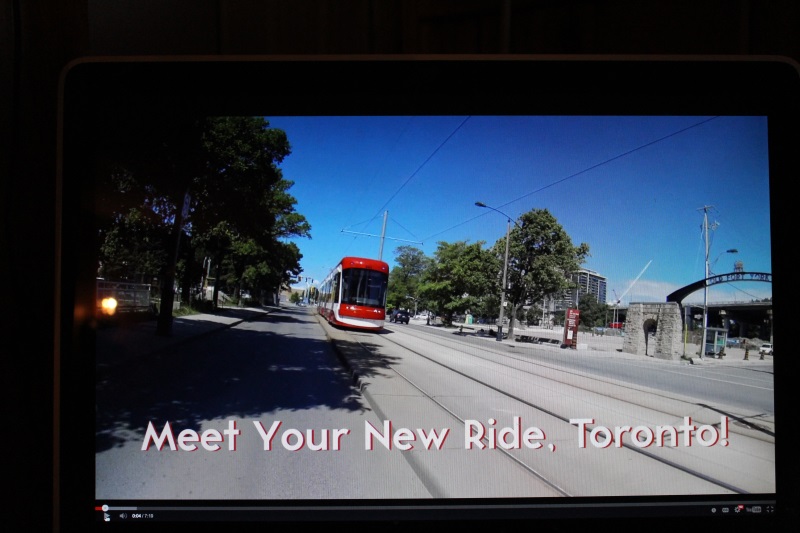
The TTC have just released a short video outlining the features of the new streetcar. Streetcar TO have shared this link.
TTC- Streetcar News
The following are some of the projects that are underway to upgrade the TTC streetcar network for the 204 new Low Floor Streetcars (LFLRVs) that are on order
Overhead Infrastructure:
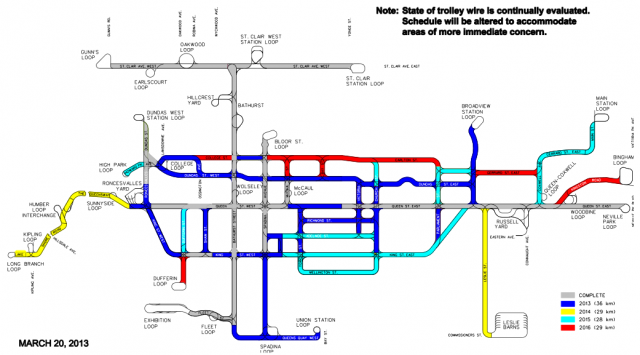
Urban Toronto.ca outlines the schedule of upgrading the overhead infrastructure and comments on some other upgrades as well.
“The new streetcars will draw 50% more current and will ultimately use a pantograph system versus the antiquated trolley poles on the current fleet. To accommodate wheelchairs and accessibility features, curb cuts and road modification will also be carried out. The map below shows an estimate of the upgrading timelines for the overhead work across the network.With work soonest to be completed on the Bathurst and Spadina upgrades, these routes will be the first to see the new vehicles in service, followed by the Harbourfront line coinciding with the completion of the Queens Quay Revitalization in 2014. Service with the new cars will then roll out to Dundas (2014/2015), Queen/Lakeshore (2015/2016), King (2016/2017), St. Clair (2017/2018), Downtowner (2018), Kingston Road (2018) and finally Carlton (2018/ 2019).”
http://urbantoronto.ca/news/2013/06/ttc-rolls-out-its-new-low-floor-streetcar-deployment-plan
Leslie Barns
A new carbarn is being constructed at Lakeshore Blvd. and Leslie Street. A connecting track is being built from the carbarn, up Leslie Street, connecting with the Streetcar network at Queen Street. This track construction and overhead installation is currently underway and will be completed this summer. The new carbarn will be completed by 2016.
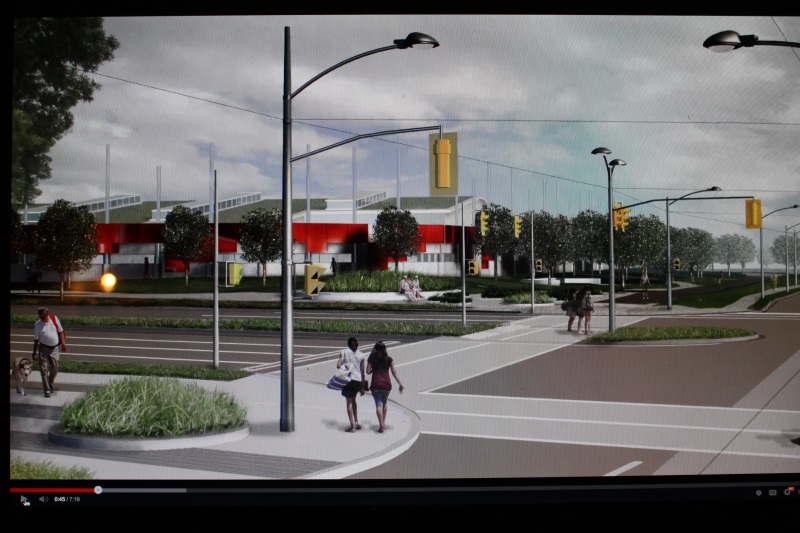
Artist’s sketch of the completed Leslie Carbarns, looking southward across Lakeshore Boulevard at Leslie Street.
It will be built to Toronto Green Development standards, with a storm water management pond, new trees and enhanced streetscaping. Russell (Connaught Avenue) and Roncevalles Carhouses will remain open to store approximately half of the new streetcar fleet.
Source: https://www.ttc.ca/About_the_TTC/Projects/Leslie_Barns/index.jsp
Leslie Carbarns Connecting track:
A double track connector link is being constructed from the intersection of Queen and Leslie through the intersection of Lakeshore and Leslie and then eastward into the new Leslie Carbarns. Only the trackwork at Queen and Leslie is complete. Work on the underground utilities along Leslie Street is underway.
This is the status of construction at Queen and Leslie.
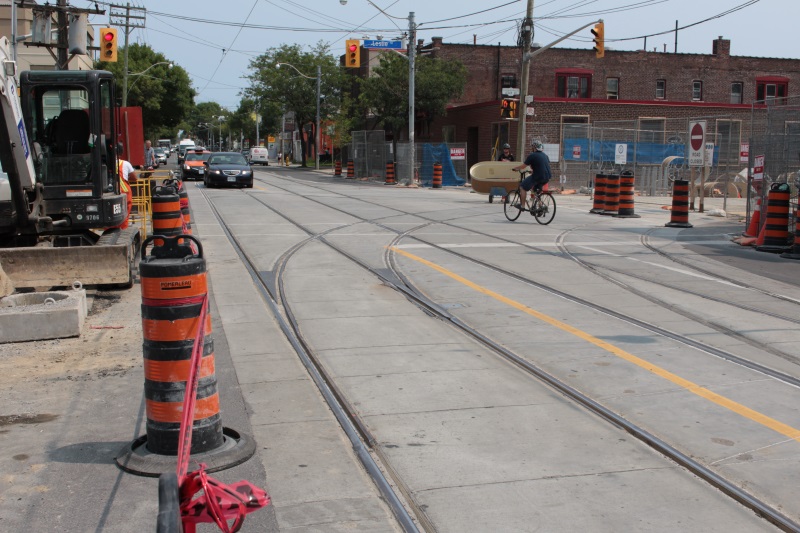
Looking eastward on Queen Street John Jeffery photo
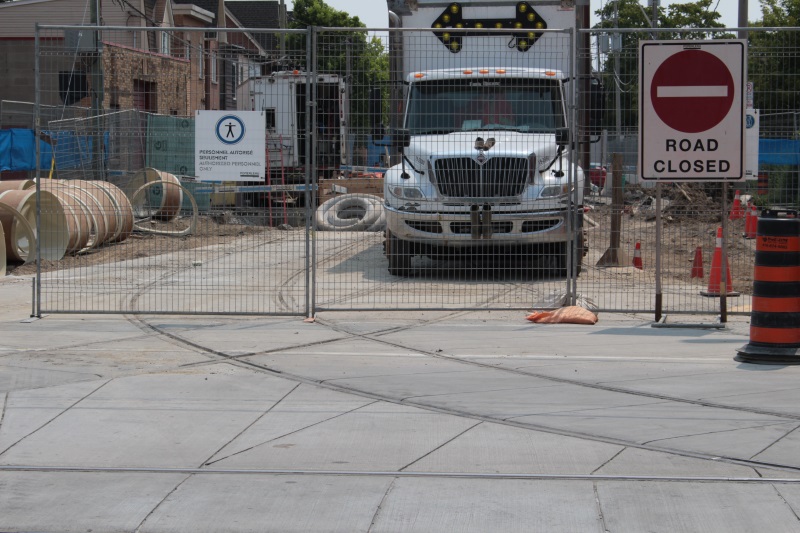
Looking southward on Leslie Street from Queen Street
John Jeffery photo
There are many more projects going on, in total, to upgrade the Streetcar Network. Follow this link for full details on this and all TTC projects:
http://www.ttc.ca/About_the_TTC/Projects/index.jsp
MEET YOUR RIDE
Rollout Schedule
On August 31, the new streetcars started service on the 510 Spadina route. The vehicle rollout schedule for all streetcar routes will take several years to complete.
510 Spadina Line
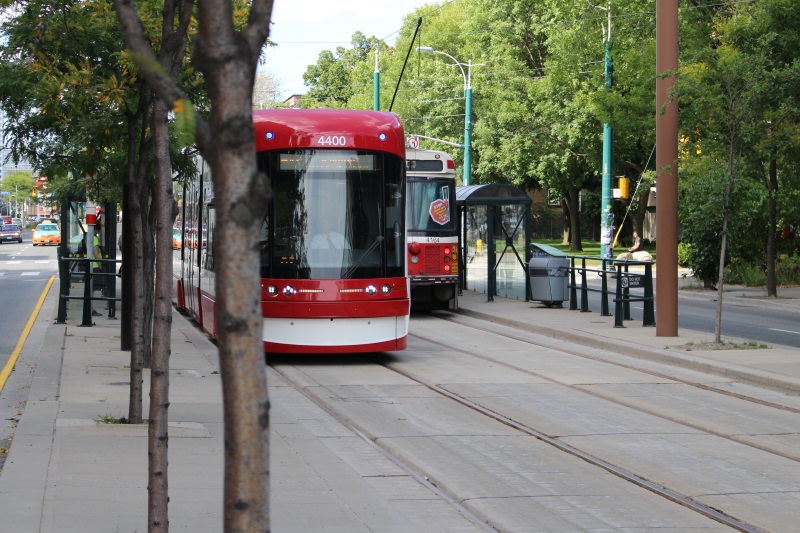
Aug 31st , 2014, ttc 4400 southbound on Spadina line at Sussex Ave.
John Jeffery photo
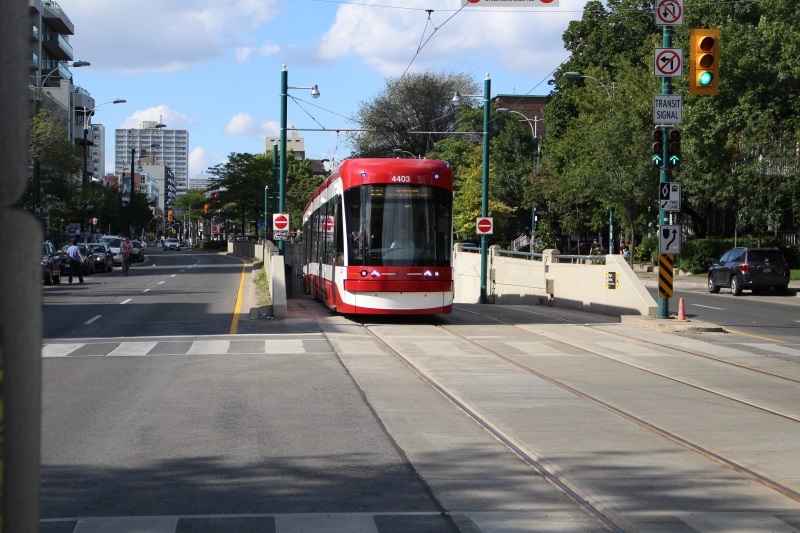
Caption: August 31st, 2014 TTC 4403 southbound on the 510 Spadina line, exiting Bloor station access tunnel at Sussex Ave.
John Jeffery photo
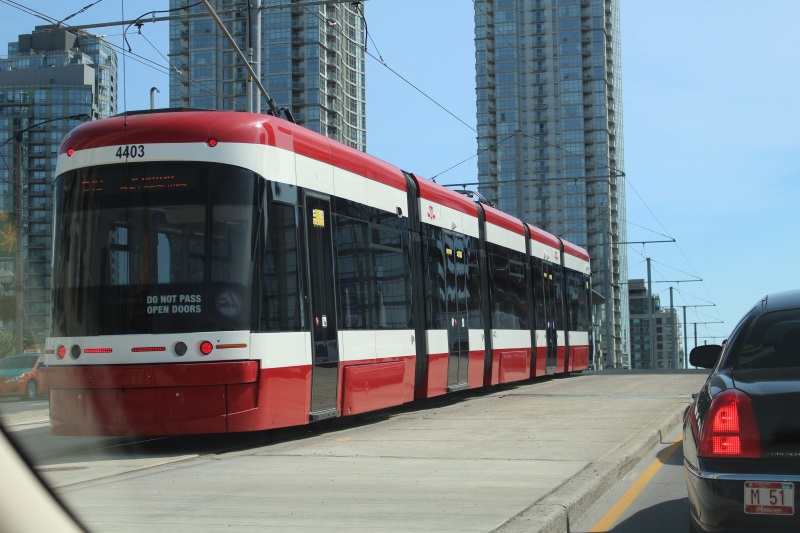
Sept 19thth Metro Dome John Jeffery photo , 2014 TTC 4403 southbound on the 510 Spadina line at
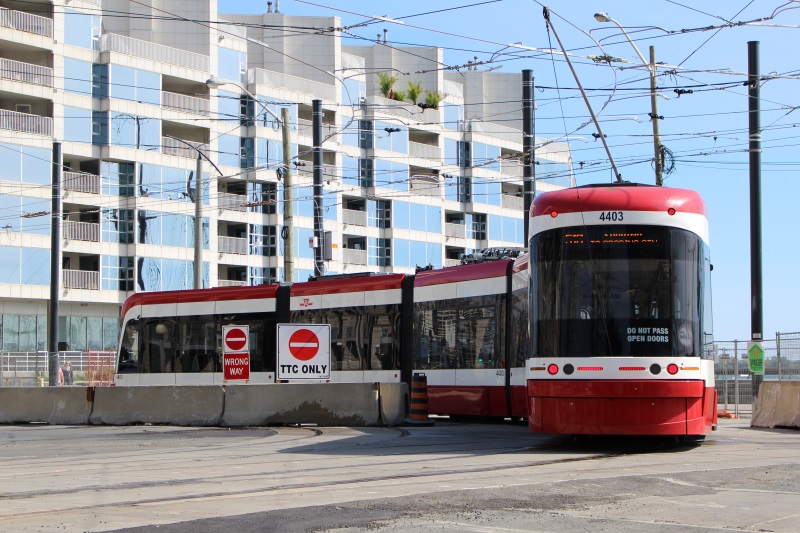
Sept 19th Quay. You can see the connecting trackage to the Queens Quay line in the foreground. The 509 Harbourfront line reopened on October 12th Exhibition loop and the Union Station tunnel at Bay Street. Both the 509 and 510 lines share this trackage between the Spadina loop and Bay Street. , 2014, ttc 4403, flexing to enter the Spadina loop at Queens between
John Jeffery photo
509 Harbourfront Line
Streetcar Route map: Click on the link below to open the map
http://www.ttc.ca/images/fixedImages/TTC_Streetcar_network_map_August-2014-WEB.pdf
On October 12th,2014 allowed that route to reopen between Exhibition loop and Union, but also allowed 510 cars to once again share the Queens Quay trackage between Spadina loop and Union. When the 510 route first reopened on August 31st the Spadina loop, which they do sometimes in regular service, at rush hour. Now they can operate over the entire 510 line from Bloor Station, down Spadina, eastward along Queen’s Quay to the Union station access tunnel at Bay street. the 509 Harbourfront line was reopened along Queens Quay. It cars had to short turn at
509 cars operate from Exhibition loop, eastward along Fleet Street, south on Bathurst one block and eastward along Queen’s Quay, past Spadina Loop, to the Union Station access tunnel. There both routes can access the Union station streetcar platform, where riders can access the upgraded Union subway station across the platform.
“The construction of TTC infrastructure is only one part of the massive Queens Quay revitalization project which is on schedule for summer 2015. From Lower Spadina Avenue to Bay Street, the project is completely rebuilding Toronto’s main waterfront street both above and below ground. Here are a few photos, highlighting recent construction progress along Queens Quay as we transform the street into a beautiful centrepiece of the waterfront.”
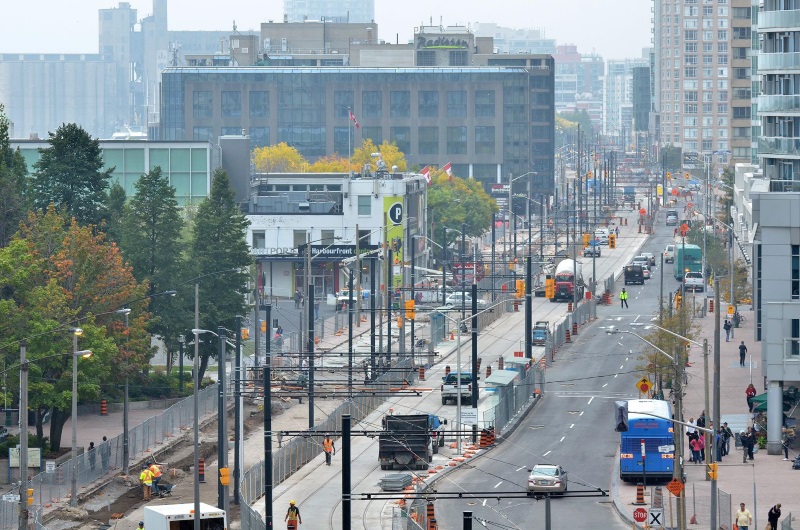
This picture shows the Queens Quay streetcar trackage as of October 12th 2014. By Spring 2015 all of the improvements will be complete.
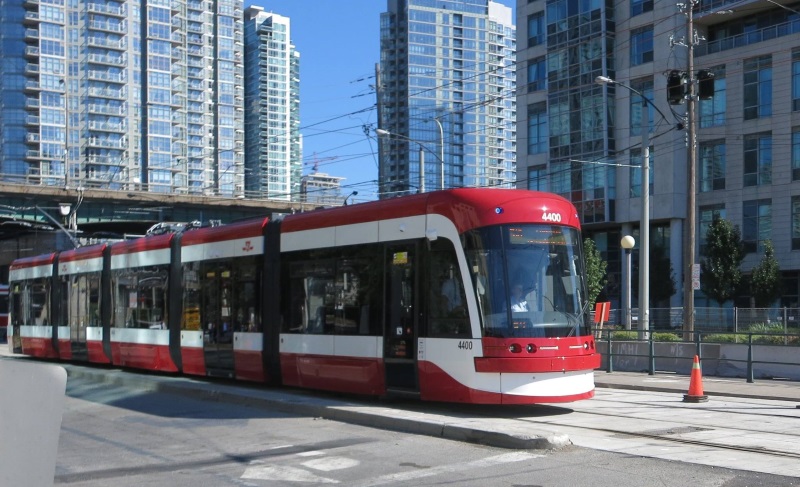
TTC 4400 is shown eastbound on Queens Quay, testing the upgraded trackage, prior to the re-opening for regular service on October 12th
Source: Waterfront Toronto: https://www.facebook.com/media/set/?set=a.10152362055327927.1073741862.151607887926&type=1
New TTC Subway Cars:
The new class of subway cars are accessible and designated as The Toronto Rocket. They are built by Bombardier in Thunder Bay, ON, and are being delivered over a three year period. They are assigned exclusively to the Yonge- University Spadina line. Deliveries have been interrupted by the strike at the Thunder Bay plant, which is now over.
The TTC’s new subway trains are a “six-car-fixed” configuration with open gangways and which will enable riders to move freely from one end to the other. Each train is comprised of two cab cars (one at each end) plus four non-cab cars.
Toronto Rocket trains are equipped with evacuation ramps at each end of the train. These detrainment devices can be easily deployed in a matter of seconds to allow for quick and easy evacuation.
Source: https://www.ttc.ca/About_the_TTC/Projects/New_Vehicles/New_Subway_Train/index.jsp
TTC Subway Projects:
Spadina – York Subway Extension
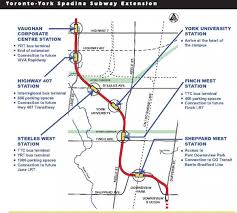
Map of the Spadina – York subway extension.
Track, Signal, Fare Collection Systems, Communications and Integrated Controls Works continue until 2016.
Opening of the extension is anticipated for the fall 2016.
Source: http://www.ttc.ca/Spadina/Tunnelling/Construction_Schedule.jsp
Follow this link to view progress on the various projects on this extension
http://www.ttc.ca/Spadina/About_the_Project/Photo_Gallery/index.jsp
Automatic Train Control - Yonge – University – Spadina line:
This will allow headways of ninety seconds once the work is complete in 2018. Work is being carried out on weekends only , with closures of sections of the line required because of the labour intensive nature of the work.
Source: https://www.ttc.ca/About_the_TTC/Projects/Automatic_Train_Control/index.jsp
Station improvements:
Follow this link for a complete report on the station improvements being carried out:
https://www.ttc.ca/About_the_TTC/Projects/Station_Improvements/index.jsp
TTC - Union Station - Second Platform

Cross section of Union Station second platform
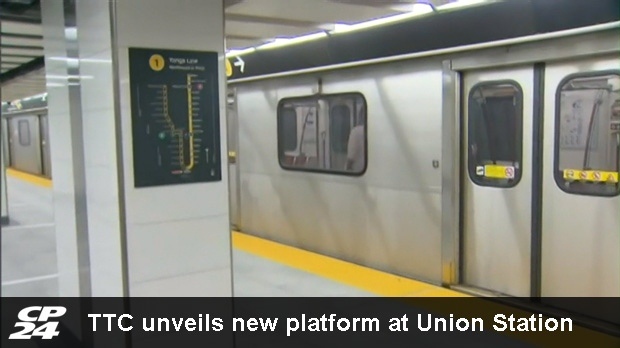
On August 18th, 2014 the TTC opened the new second platform at the concourse and platform levels of TTC Subway station at Union Station.
For full details and pictures on the progress of this expansion at Union Station, click on the link below.
http://www.ttc.ca/About_the_TTC/Projects/Station_Improvements/Union_Station/index.jsp
TTC - Vignettes
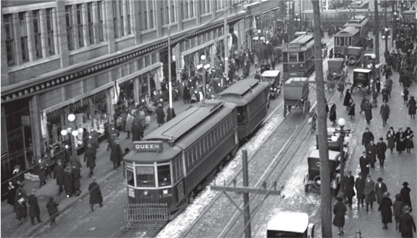
A 1921 view of Queen Street looking east to Yonge Street
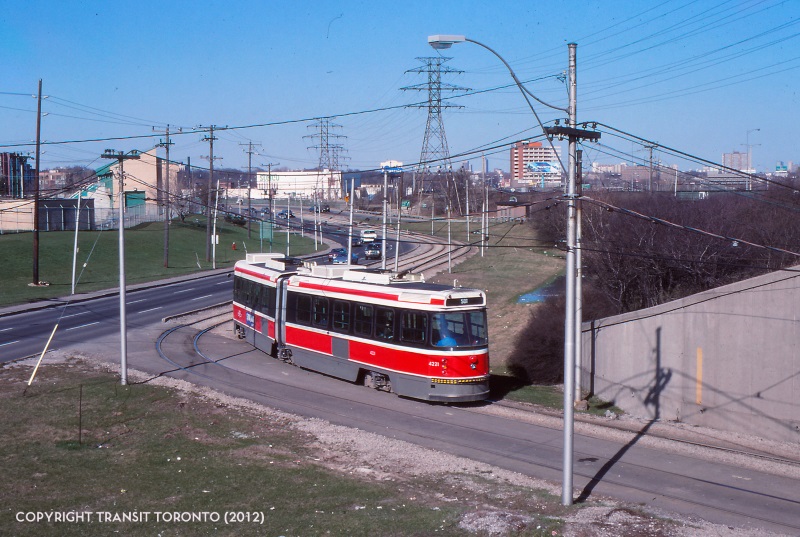
Caption:Route 501 TTC CLRV 4039 picks up passengers at Humber Loop for a long journey east to Neville Park. The "safety shield" skirt is already installed on this vehicle.
Gloucester Subway cars at Davisville Yard in Toronto.
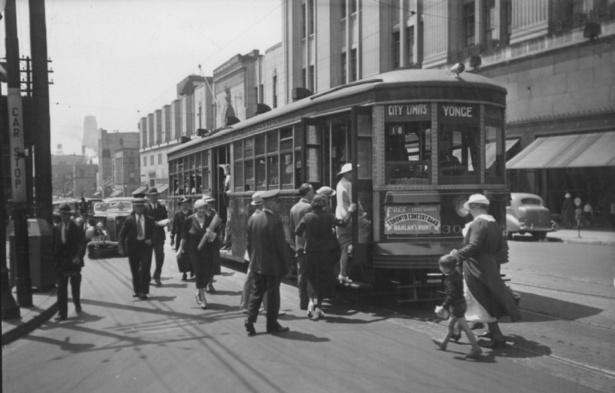
Source for all four vignette photographs:
https://www.ttc.ca/About_the_TTC/History/The_first_75_years.jsp
Union Pearson Express division of Metrolinx
UP Fleet Status Report – October 24th,2014: (Mark Ostler – Metrolinx)
Eighteen Diesel Multiple units are on order from Sumitomo in Japan, with final assembly and testing at Nippon Sharyo in Rochelle Illinois. Units will be delivered in pairs on an ongoing basis and are equipped for Tier 4 emissions.
UP 1001 – 1002 - Units currently based at Willowbrook Yard, undergoing operational testing and commissioning. Crew training with Bombardier crews is being carried out at this time as well.
UP 1003 - At Nippon Sharyo in Rochelle Illinois for completion and testing. They will be forwarded to CN MacMillan Yard sometime in November, and then to GO Willowbrook for commissioning runs and crew training.
UP 1004 and 1005 were on the end of CN 148 October 29th and were caught by Walter Pfefferle as they rolleed through Ingersoll Ontario on their way to Mac Yard.

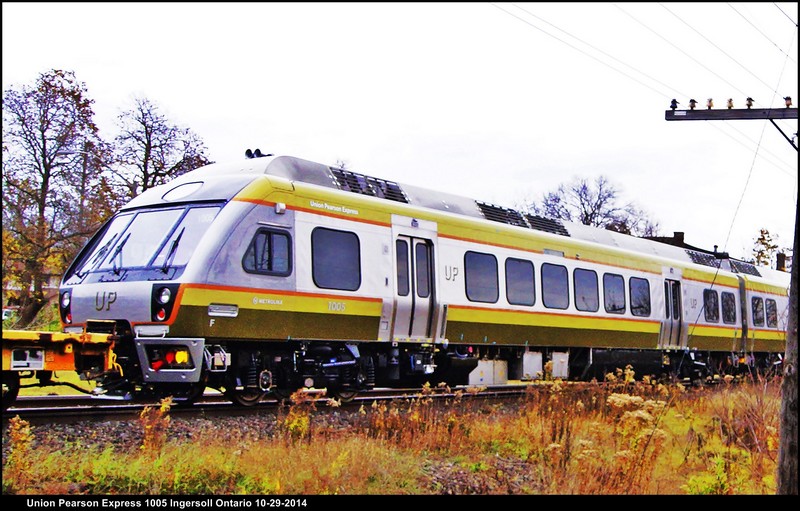
UP 1006 – 1018 - Under construction at Sumitomo in Japan. Shipped to Rochelle, Illinois in pairs for final assembly and testing.
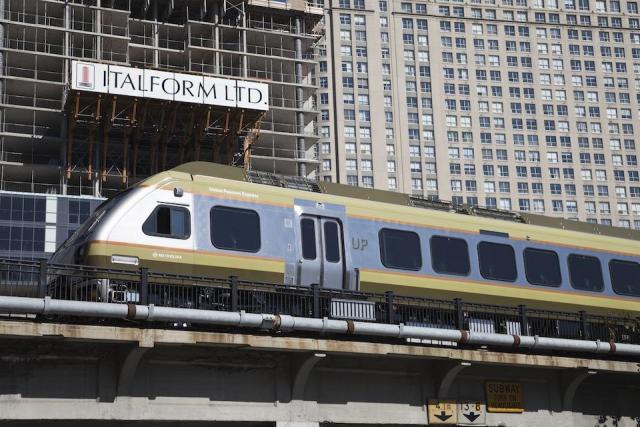
A Union-Pearson Express train over Yonge Street in downtown Toronto,image by Jack Landau
Source: http://urbantoronto.ca/news/2014/09/union-pearson-express-trains-now-testing-toronto
Other GO Transit News
Union Pearson Express division of Metrolinx
Status update – October 24th , 2014 (Mark Ostler – Metrolinx)
Click on the link below to watch a short You Tube video about the Union Pearson Express project.
On the same page is a short video clip showing an animation of the three km airport spur which runs from the GO Kitchener Sub into Terminal One of Pearson Airport.
http://www.metrolinx.com/en/projectsandprograms/upexpress/upexpress.aspx
Alex Titu posted a picture of UP 1001 and 1002 testing on the CN Oakville Sub. On Sunday, September 14th , 2014. Here is his report.
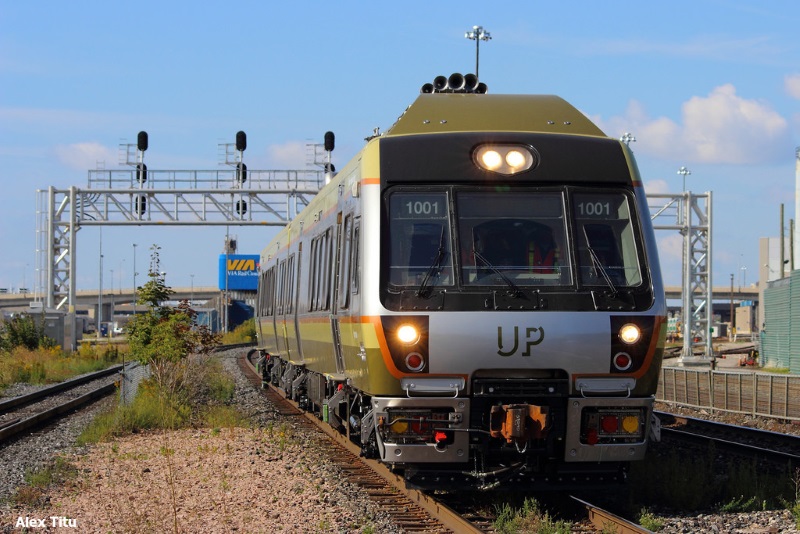
Thanks to some excellent information from a few friends, I was able to make it out to Etobicoke to witness the mainline test run of the Union Pearson Express units 1001, and 1002. They were given a permit to occupy tracks 3 and 4 on the Oakville Subdivision between Canpa and Gardiner. During the few hours of testing, they ran the train back and forth between these two points several times. I believe they tested the doors and made a brief stop at Mimico as well.
Source: http://www.railpictures.ca/?attachment_id=16362
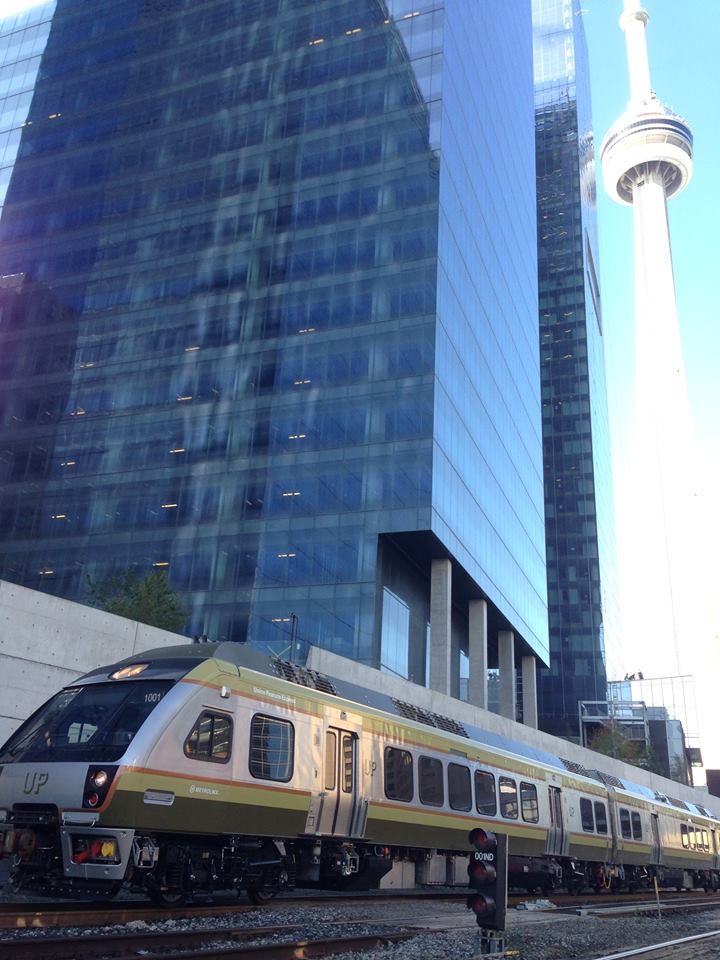
UP Express is continuing its operational testing of UP 1001 and 1002. Here are the units testing on September 25th at Union Station.
The UP terminal at Pearson Terminal One is complete. The Metrolinx office at West Toronto advises that the trackwork on the airport spur is also complete. Trackwork on the GO Kitchener sub from Union Station to Pearson Airport is ongoing. A number of infrastructure projects as part of the Georgetown South project are underway. The Bridge at Strachan Avenue is almost complete as is the the West Toronto Diamond project. A number of bridges along the line are being widened or strengthened and stations at Bloor and Weston are also being substantially upgraded. A new Union Pearson terminal at Union station is currently under construction at the west end of the station.
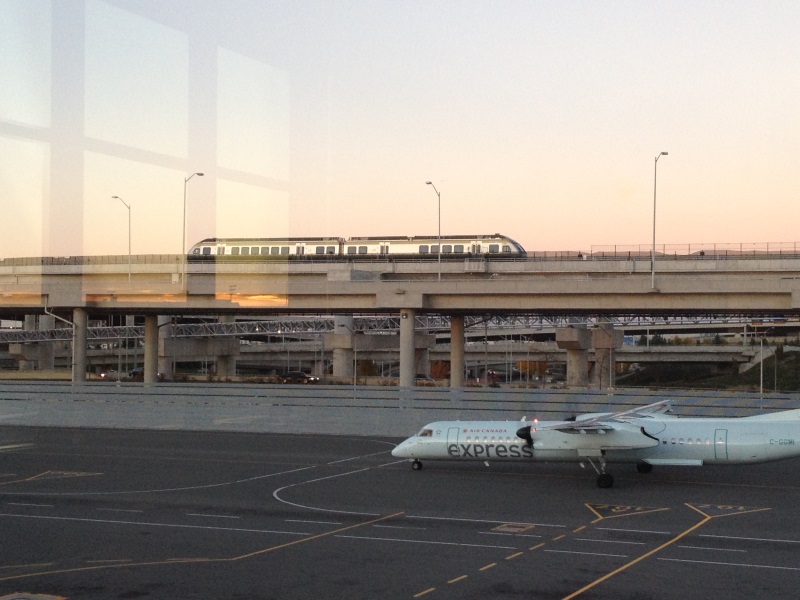
Chris Inwood, who flies for Air Canada, took this picture on October 23rd of UP1001 and 1002 doing operational tests on the Airport spur into UP Pearson Airport terminal. Thank you Chris for sharing this photo.
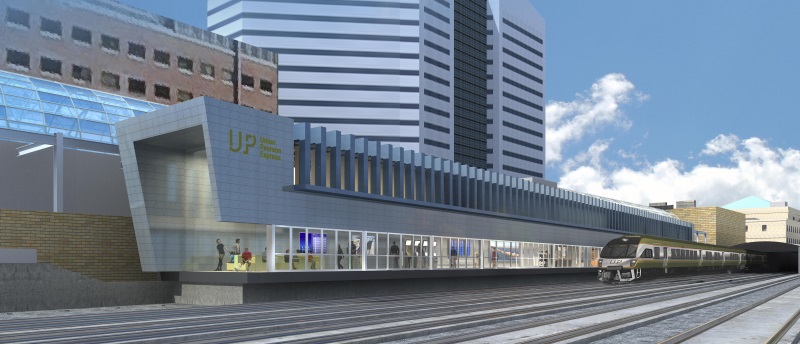
Union Pearson terminal – Union Station
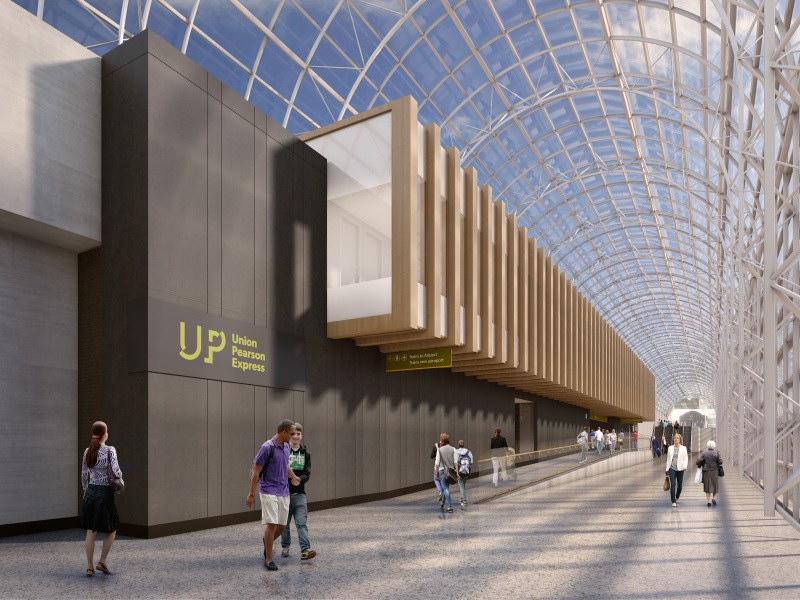
The UP Express website gives this description of the station:
“Located within the existing Skywalk in downtown Toronto, the new station will be connected to Union Station via the Skywalk’s interior walkway, enabling guests to travel between the two rail terminals without having to go outside. And even while waiting for the next train, passengers will be sheltered by the fully enclosed platform, built and used solely for the Union Pearson Express. The combination platform/waiting area will be an enclosed space, featuring a customer service desk, ample seating, automated ticket vending machines, fare card validators and accessible washrooms. “
http://www.upexpress.com/en/project/project.aspx#community
For more complete descriptions of all Union Pearson Express stations click on the link below.
http://www.upexpress.com/en/project/stations.aspx
WCE 902 pushing in the trailing position arriving at Port Haney Station in July 2006.
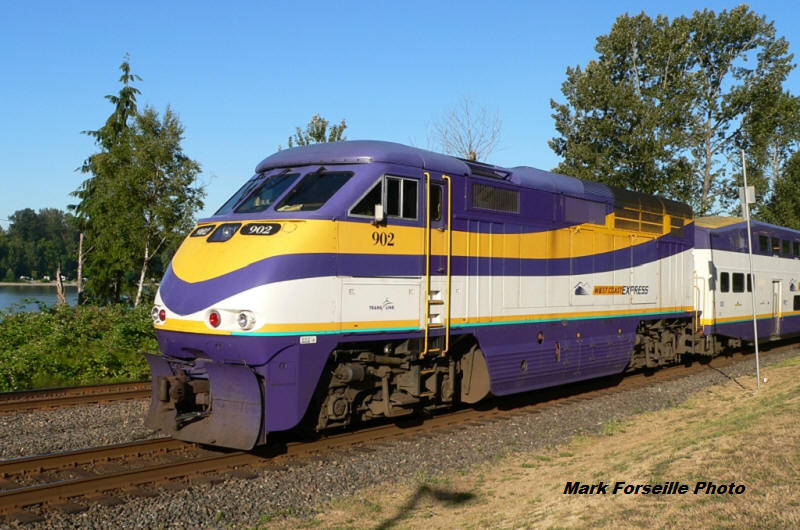
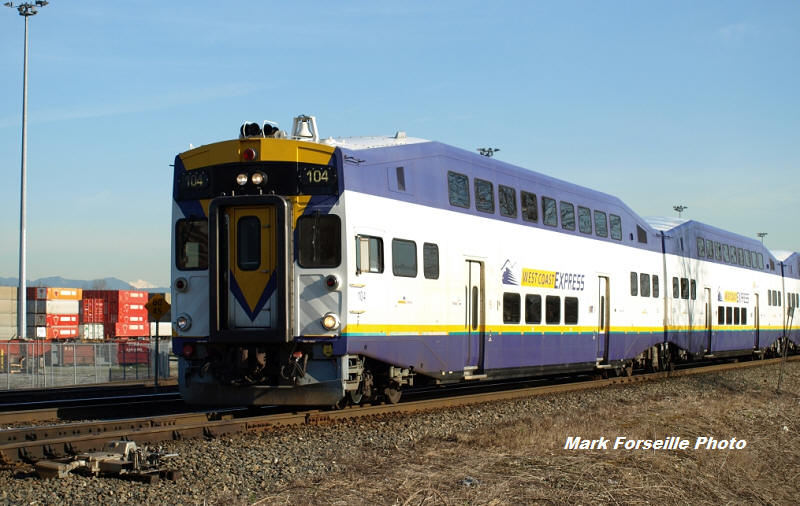
WCE Cab Control Car #104 heading west at Pitt River from Pitt Meadows, BC to Port Coquitlam, BC in Feb 2010.
AMTRAK IN CANADA
(Edited by William H Baird)
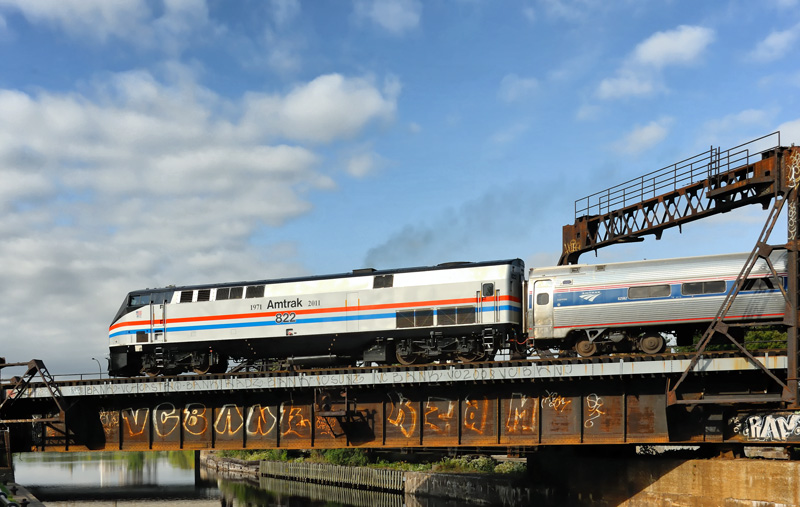
Frank Lenny Smith caught good looking AMTRAK Heritage P42 822 crossing the Lachine Canal down by Wellington Tower (Montreal) the morning of September 10th.
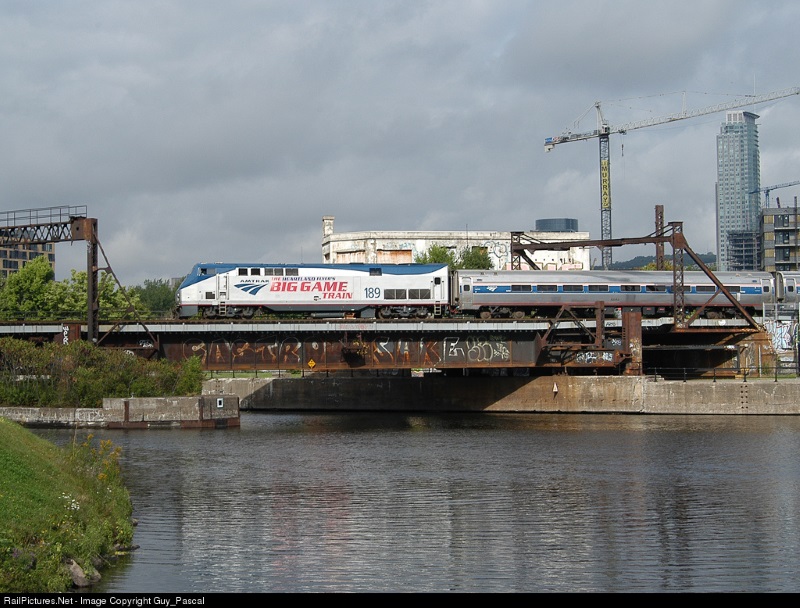
On September 1st, Guy-Pascal Arcouette snapped AMTRAK P42DC 694 on Wellington bridge, departing Montreal, QC. Note the train is lead by the "Big Game Train" AMTK 189 promo locomotive which was again on the Montreal train October 20th!
http://www.railpictures.net/viewphoto.php?id=496148&nseq=0
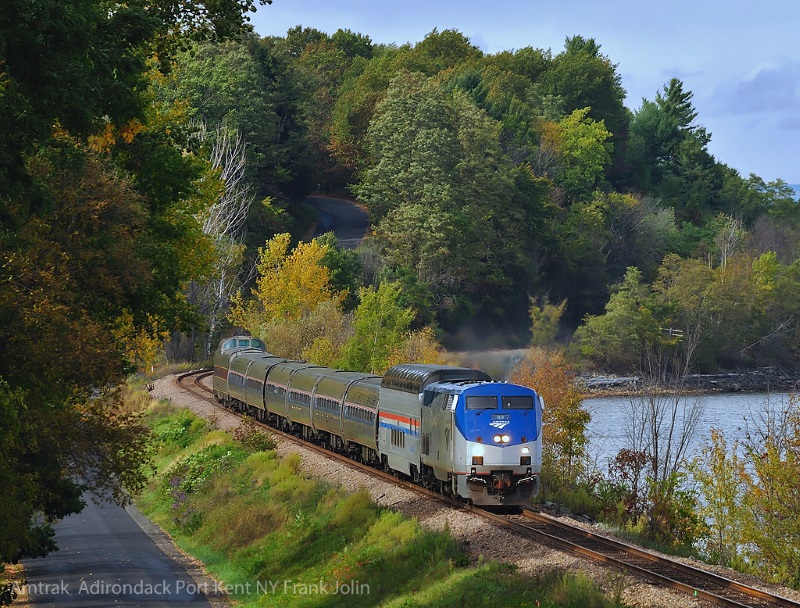
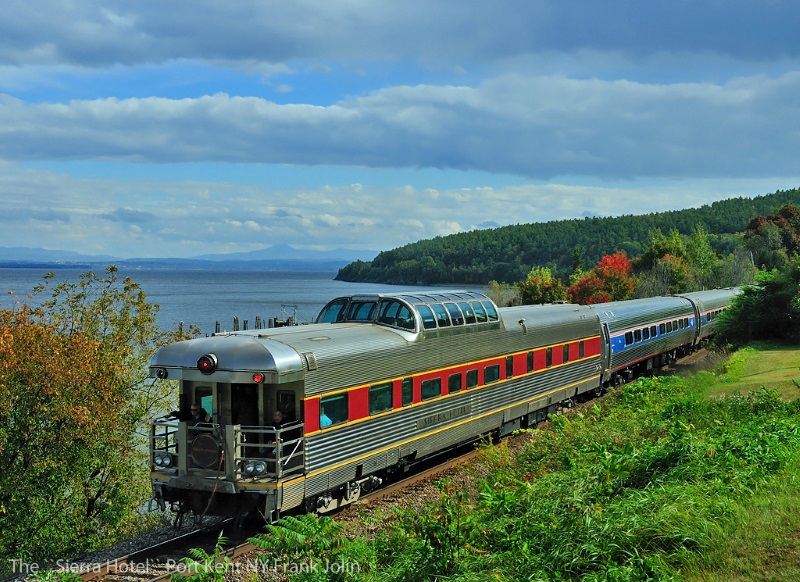
Francois Jolin submitted these two photos of AMTK #68 at Port Kent, NY
Amtrak train #68 the "Adirondack" skirts the shores of Lake Champlain at Port Kent, NY, with the "Ocean View" dome car, and private car "Sierra Hotel" on a mild and breezy October 7th, 2014
http://www.railpictures.net/viewphoto.php?id=501141&nseq=11
"Sierra Hotel" looks like the place to be adorning the tail end of the Adirondack.
http://steelribbon.smugmug.com/Other/Sierra-Hotel/44832407_hCKSDZ#!i=3595907037&k=HxKL8w9&lb=1&s=A
Please submit your AMTRAK IN CANADA Photos for CRO directly to William H. Baird at: editor@canadianrailwayobservations.com
© CRO November 2014